
Upcoming Trainings and Events
Staff Courses
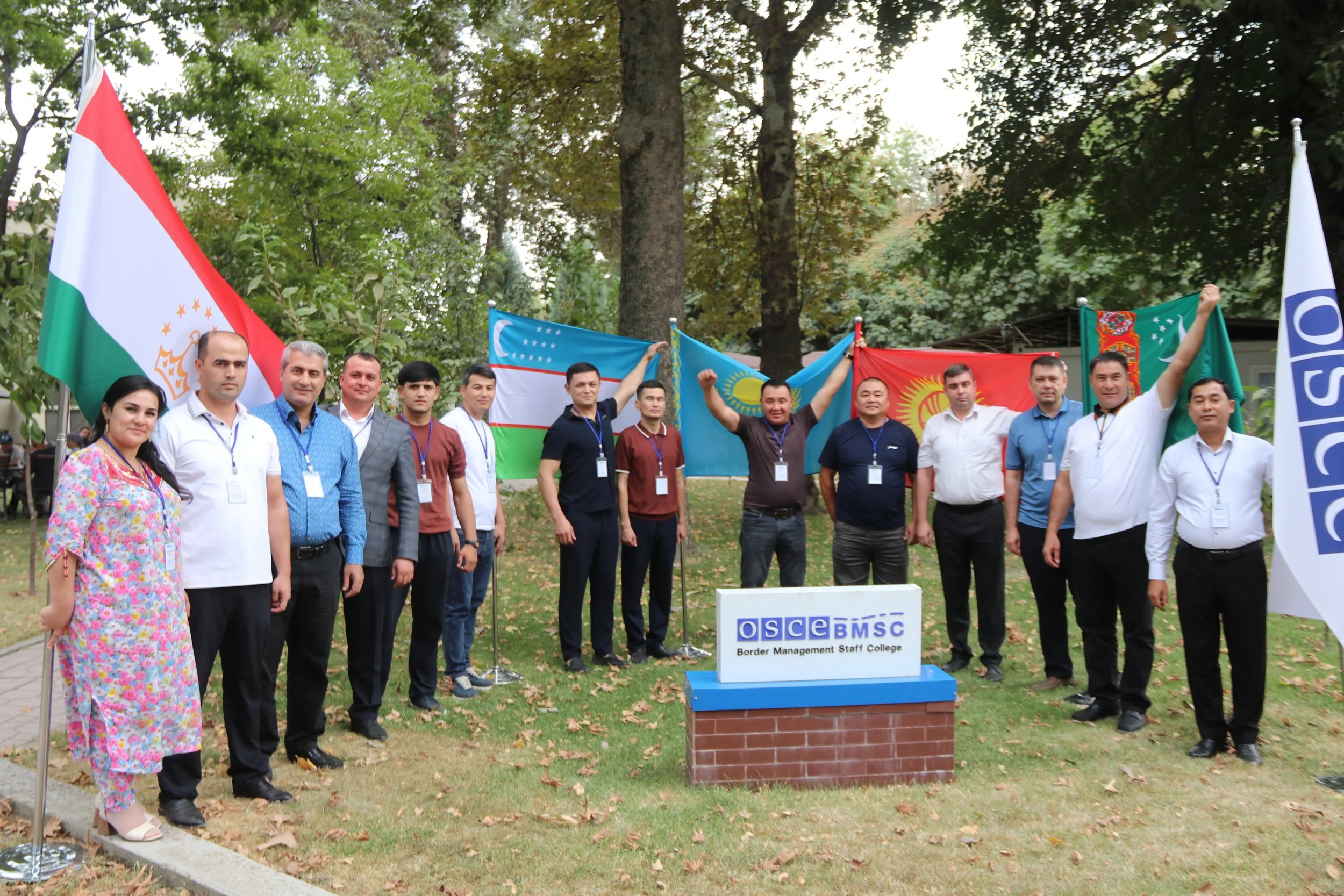
Who should apply
The course is intended for mid-level professionals who:
Have 2–5 years of operational experience
Are employed by a national authority responsible for border management, border troops, border guards, border police, customs, migration, or drug control
Are motivated to strengthen community-focused border practices
Demonstrate potential for increased responsibility within their agencies
Are willing to actively engage in BMSC alumni networks and share knowledge within their home institutions
Course format
Week 1: Online preparatory module
Weeks 2–4: In-person training at BMSC in Dushanbe
Application deadline
21 February 2026 (23:59 GMT+5)
41st Staff Course
7 April – 1 May 2026
One week online | Three weeks in Dushanbe
The Border Management Staff College (BMSC) invites nominations for the 41st Border Management Staff Course, an intensive, practice-oriented programme designed to strengthen leadership, operational effectiveness, and cooperation among border management professionals across the OSCE region.
This edition of the Staff Course places a strong emphasis on community engagement, highlighting the role of trust, communication, and cooperation in effective and secure border management.
Webinars
Working Together to Stop Drug Trafficking at Sea
May 20, 2026 14:00 GMT +5This webinar will explore how border and law enforcement agencies work together to address maritime drug trafficking and irregular migration. It will provide a short overview of current risks, followed by practical examples of how countries share information, coordinate operations, and respond to cross-border challenges. Participants will also discuss common challenges and exchange ideas on how to improve co-operation in their own contexts.
Our Experts:
Dr Aynura Salleh
Associate Programme Officer
Global Maritime Crime Programme, UNODC
Enhancing Border Security through Coordinated Customs Practices: Combating Organized Crime and Smuggling while Supporting Trade Facilitation
APRIL 2, 2026 14:00 GMT +5Co-ordinated Customs practices support secure border controls while facilitating legitimate trade. Uneven, manual, or non-risk-based procedures can cause delays, duplicate work and reduce the ability to target high-risk consignments linked to smuggling and other illicit cross-border activity.
Using examples from Japan and Norway, the webinar will examine how Customs services apply co-ordinated border management and risk management. It will cover targeted controls, non-intrusive inspection, digital procedures and co-operation with other border agencies, and end with practical takeaways for participants.
Our Experts:
Yuko Tsuda Carina Berg Fremstad
Deputy Director Customs Officer and Second-in-Command
International Cooperation Division Svalbard, Norwegian Customs
Customs and Tariff Bureau BMSC Alumnu
Ministry of Finance, Japan
BMSC Alumna
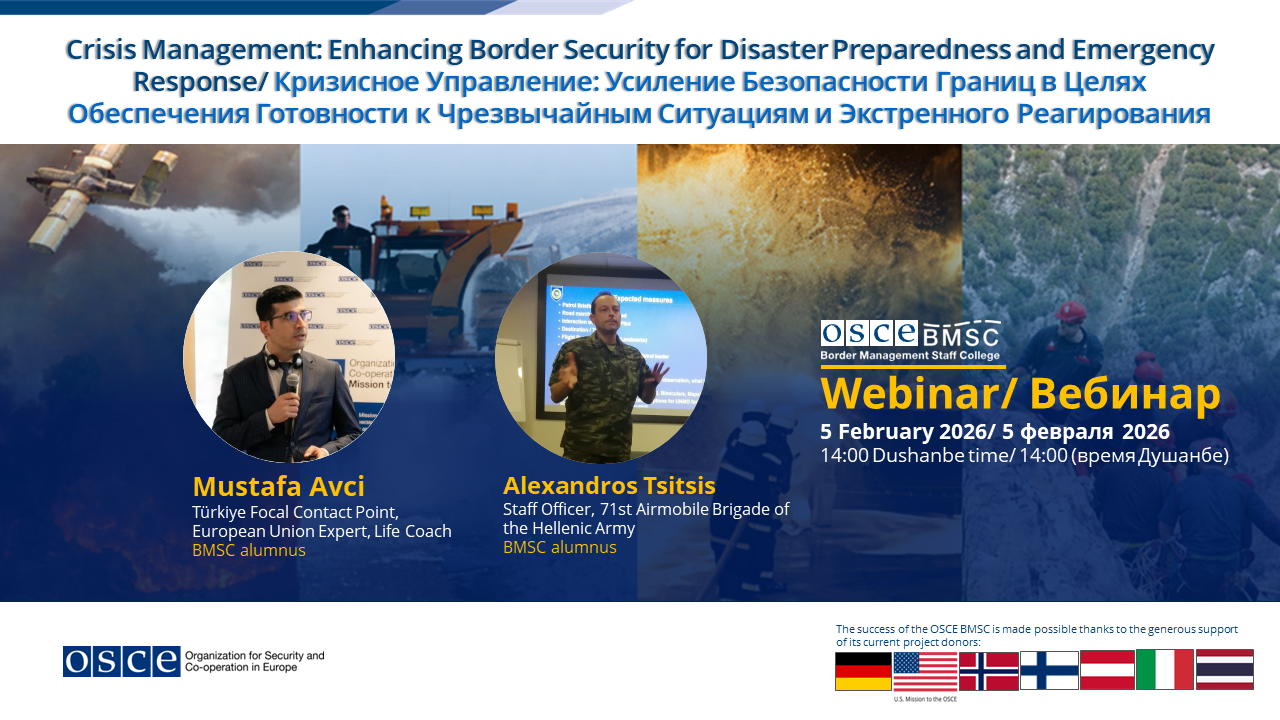
Crisis Management: Enhancing Border Security for Disaster Preparedness and Emergency Response
FEBRUARY 5, 2026 14:00 GMT +5The OSCE Border Management Staff College (BMSC) is organizing a webinar for its alumni community on crisis preparedness at borders. The session will examine how border security and management agencies can prepare for and respond to natural disasters and other emergencies through contingency planning, stronger inter-agency coordination and cross-border cooperation.
Using national case studies from Türkiye and Greece, it will focus on continuity of border operations, command and communications arrangements, and the secure movement of affected people, emergency personnel, humanitarian relief supplies, and essential goods. It will also highlight the importance of timely information-sharing and coordinated measures during climate-related emergencies.